Monday, May 12, 2008

India Had 261 Mobile Million Subs End March; Only 3.9 Million Broadband Subs


Recently , I read some interesting statistics , India has become the second largest wire less network in the world with over 261 Mn mobile subscribers. This creates an enormous opportunity for the Mobile eco system which includes equipment , handsets and above all mobile content. Reliance took the leap by offering the handsets at throw away prices to start this rally. Now the mobile companies should think on the data pricing to kick start a boom on the mobile content market.

With a smart phone , I have clocked almost 189MB of data last month . With my broadband usage on my home PC  was 400 MB. This means I browse more content on my handheld than on my PC because of  file down load through my broadband. This trend is clear by the number of content aggregators proving content for mobile phones - smart  or feature phones alike.

At the same time , India's network infrastructure needs a great overhaul to cope with the demand and the number 2 status we have in subscriber base.

" As per a TRAI release, India became the second largest wireless network in the world, by the end of March. India now has over 261.09 million wireless subscribers, with 10.16 million subscribers added in March 2008 alone. If I remember correctly, we were adding between 7-9 million subscribers every month last year, so the rate of addition of subscribers appears to be increasing. The teledensity is now at 26 percent. March was a particularly good month, given the context that 8.53 million subs were added in February.

Download the report here. "


At the same time , India's network infrastructure needs a great overhaul to cope with the demand and the number 2 status we have in subscriber base.

India scored 4.06 garnering a rank of 50 out of 127 countries on a Networked Readiness Index (NRI) ranking for 2007-200. The report published by the World Economic Forum in cooperation with INSEAD basis rankings on 70 indicators, more details here. The report covers 127 economies, accounting for around 95 percent of the world’s GDP. 

Since 2002, the largest variable regression in India’s Network Readiness Index is in its Market environment which deteriorated from a rank of 28 in 2006 to 49 in 07. Surprisingly, the only improvement has been in the Political and regulatory environment which has improved from 48 to 47 during the same period. The graph below maps trends from 2002 - 2007.

Do a head to head with China and a few surprises come up. India leads in venture capital availability with a score of 4.12 compared to China (2.98). Counter this with the fact that China betters India on a majority of consumption metrics including Internet users, bandwidth, mobile telephone subscribers and internet access in schools. Overall, India’s network readiness index has dropped from 44 in 06 to 50 in 07, it has remained consistent in its non performance in 07-08. China is currently at 57. The list of most networked economies of the world is is led by Denmark (5.78), followed by Sweden (5.72) and Switzerland (5.53). In descending order of rankings for favourite immigrant haunt, US (4), UK (12), Canada (13) and Australia (14). In case you are a cricket fan, we lead Pakistan (89) by 39 ranks.

Friday, May 09, 2008

Indian Ads - Jingle All the Way

Indian Ads were once known for the jingles . We have heard many catchy jingles when we were young . Do you remember - Kya Swad Hai Jindgi ( Cadbury's) , Ye Zamin Ye Aasman ( Bajaj ) , Doodh Doodh ( NDDB) , Jab mein Choota Bachha Tha ( Bajaj Bulbs) , Aoo chale hum leke apni TOBY Cycles etc


Where are those Jingles gone now ? I can off late only think of Vodafone/ Hutch ( You and I ). The Indian ads have become more sleek and intellectual and do not warrant for a catchy jingle . I happened to see the latest Max New York Life Insurance ad with a just a story with no music , no jingle playing at the background. Still the effect was amazing.


Indian ads are changing ....

Wednesday, May 07, 2008

What a Saree


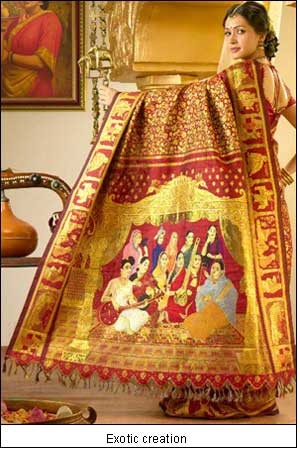
saree How often have you come across a INR 4 Million ($100,000) silk saree?  ( Saree is one of the beautiful garment worn by Indian women . It is draped around the body in many ways and looks really stunning ) Chennai Silks, a textile unit has come up with one of its kind and it is seeking an unmistakable entry into the Guinness Book of World Records for being the most unique and expensive saree.

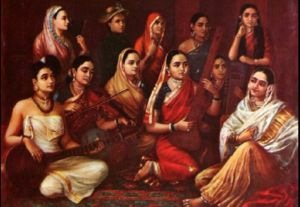
The exceptionally stunning saree is meticulously woven with 12 precious stones and metals to depict 11 of Raja Ravi Verma's popular paintings. Explicitly projected is 'Lady Musicians', one of the painter's very famous works that displays women belonging to diverse cultural backgrounds.

Besides, the border of the saree pictures 10 other paintings of the artist that pays tribute to 20th century artist. The best part of the saree being that the women in the paintings are intricately hand-woven and beautified with jewels of gold, diamond, platinum, silver, ruby, emerald, yellow sapphire, sapphire, cat's eye, topaz, pearl and corals.

Already in the Limca Book of Records, this saree will be the first silk saree that required the use of 7,440 jacquard hooks and 66,794 cards during the weaving process. Moreover, a group of consummate workers took nearly 4,680 hours to make this.

Styles of draping ( Courtesy Wiki pedia article on Saree)

300px-Ravi_Varma-InstrumentsThe most common style is for the sari to be wrapped around the waist, with the loose end of the drape worn over the shoulder, baring the stomach. However, the sari can be draped in several different styles, though some styles do require a sari of a particular length or form. The French cultural anthropologist and sari researcher, Chantal Boulanger, categorizes sari drapes in the following families.


  • Nivi – styles originally worn in Tamil Nadu; besides the modern nivi, there is also the kaccha nivi, where the pleats are passed through the legs and tucked into the waist at the back. This allows free movement while covering the legs.
  • North Indian/Gujarati – this style differs from the nivi only in the manner that the loose end is handled: in this style, the loose end is draped over the right shoulder rather than the left, and is also draped back-to-front rather than the other way around.
  • Maharashtrian/Kache – This drape (front and back) is very similar to that of the male Maharashtrian dhoti. The center of the sari (held lengthwise) is placed at the center back, the ends are brought forward and tied securely, then the two ends are wrapped around the legs. When worn as a sari, an extra-long cloth is used and the ends are then passed up over the shoulders and the upper body. They are primarily worn by Brahmin women of Maharashtra, Karnataka, Andhra Pradesh and Tamil Nadu.
  • Dravidian – sari drapes worn in Tamil Nadu; many feature a pinkosu, or pleated rosette, at the waist.
  • Madisaara style – This drape is typical of Brahmin ladies from Tamil Nadu and Kerala
  • Kodagu style – This drape is confined to ladies hailing from the Kodagu district of Karnataka. In this style, the pleats are created in the rear, instead of the front. The loose end of the sari is draped back-to-front over the right shoulder, and is pinned to the rest of the sari.
  • Gond – sari styles found in many parts of Central India. The cloth is first draped over the left shoulder, then arranged to cover the body.
  • the two-piece sari, or mundum neryathum, worn in Kerala. Usually made of unbleached cotton and decorated with gold or colored stripes and/or borders.
  • tribal styles – often secured by tying them firmly across the chest, covering the breasts.

Monday, May 05, 2008

8 important consumer trends for 2008


I came across this wonderful site Trendwatching  which captures consumer trends world wide and presents in a monthly briefing format. The site uses a very interesting way to capture trends by using a world wide network of 'spotters' who contribute to this 'watching' . This wide perspective really makes this briefing very unique and trust worthy. The site lists down 8 important Consumer trends for 2008 and this initiated a lot of thought in me.

t-lotsoftrends

The detailed report can be read at this link.  Looking at this site and drawing parallels to Indian context , I can start listing some trends which I observe . I encourage all the readers of this to contribute and be a "spotter ' of sort.

Keep spotting....