Indian Ads were once known for the jingles . We have heard many catchy jingles when we were young . Do you remember - Kya Swad Hai Jindgi ( Cadbury's) , Ye Zamin Ye Aasman ( Bajaj ) , Doodh Doodh ( NDDB) , Jab mein Choota Bachha Tha ( Bajaj Bulbs) , Aoo chale hum leke apni TOBY Cycles etc
Where are those Jingles gone now ? I can off late only think of Vodafone/ Hutch ( You and I ). The Indian ads have become more sleek and intellectual and do not warrant for a catchy jingle . I happened to see the latest Max New York Life Insurance ad with a just a story with no music , no jingle playing at the background. Still the effect was amazing.
Indian ads are changing ....
Friday, May 09, 2008


Wednesday, May 07, 2008
What a Saree
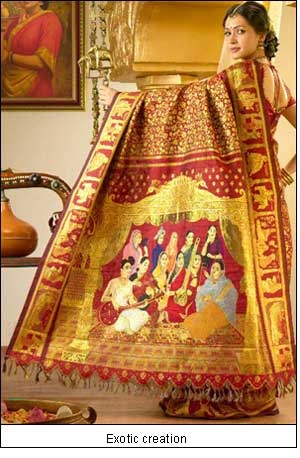 How often have you come across a INR 4 Million ($100,000) silk saree? ( Saree is one of the beautiful garment worn by Indian women . It is draped around the body in many ways and looks really stunning ) Chennai Silks, a textile unit has come up with one of its kind and it is seeking an unmistakable entry into the Guinness Book of World Records for being the most unique and expensive saree.
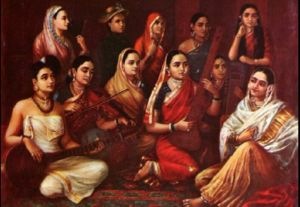
The exceptionally stunning saree is meticulously woven with 12 precious stones and metals to depict 11 of Raja Ravi Verma's popular paintings. Explicitly projected is 'Lady Musicians', one of the painter's very famous works that displays women belonging to diverse cultural backgrounds.
Besides, the border of the saree pictures 10 other paintings of the artist that pays tribute to 20th century artist. The best part of the saree being that the women in the paintings are intricately hand-woven and beautified with jewels of gold, diamond, platinum, silver, ruby, emerald, yellow sapphire, sapphire, cat's eye, topaz, pearl and corals.
Already in the Limca Book of Records, this saree will be the first silk saree that required the use of 7,440 jacquard hooks and 66,794 cards during the weaving process. Moreover, a group of consummate workers took nearly 4,680 hours to make this.
Styles of draping ( Courtesy Wiki pedia article on Saree)
 The most common style is for the sari to be wrapped around the waist, with the loose end of the drape worn over the shoulder, baring the stomach. However, the sari can be draped in several different styles, though some styles do require a sari of a particular length or form. The French cultural anthropologist and sari researcher, Chantal Boulanger, categorizes sari drapes in the following families.
- Nivi – styles originally worn in Tamil Nadu; besides the modern nivi, there is also the kaccha nivi, where the pleats are passed through the legs and tucked into the waist at the back. This allows free movement while covering the legs.
- North Indian/Gujarati – this style differs from the nivi only in the manner that the loose end is handled: in this style, the loose end is draped over the right shoulder rather than the left, and is also draped back-to-front rather than the other way around.
- Maharashtrian/Kache – This drape (front and back) is very similar to that of the male Maharashtrian dhoti. The center of the sari (held lengthwise) is placed at the center back, the ends are brought forward and tied securely, then the two ends are wrapped around the legs. When worn as a sari, an extra-long cloth is used and the ends are then passed up over the shoulders and the upper body. They are primarily worn by Brahmin women of Maharashtra, Karnataka, Andhra Pradesh and Tamil Nadu.
- Dravidian – sari drapes worn in Tamil Nadu; many feature a pinkosu, or pleated rosette, at the waist.
- Madisaara style – This drape is typical of Brahmin ladies from Tamil Nadu and Kerala
- Kodagu style – This drape is confined to ladies hailing from the Kodagu district of Karnataka. In this style, the pleats are created in the rear, instead of the front. The loose end of the sari is draped back-to-front over the right shoulder, and is pinned to the rest of the sari.
- Gond – sari styles found in many parts of Central India. The cloth is first draped over the left shoulder, then arranged to cover the body.
- the two-piece sari, or mundum neryathum, worn in Kerala. Usually made of unbleached cotton and decorated with gold or colored stripes and/or borders.
- tribal styles – often secured by tying them firmly across the chest, covering the breasts.
Monday, May 05, 2008
8 important consumer trends for 2008
I came across this wonderful site Trendwatching which captures consumer trends world wide and presents in a monthly briefing format. The site uses a very interesting way to capture trends by using a world wide network of 'spotters' who contribute to this 'watching' . This wide perspective really makes this briefing very unique and trust worthy. The site lists down 8 important Consumer trends for 2008 and this initiated a lot of thought in me.

The detailed report can be read at this link. Looking at this site and drawing parallels to Indian context , I can start listing some trends which I observe . I encourage all the readers of this to contribute and be a "spotter ' of sort.
Keep spotting....
Sunday, May 04, 2008
You ate my food
Who the FxxK is George W Bush ? ( Sorry for my unparliamentary language ) but that was the question I asked as I read this news about the this idiot saying that the current food shortage in the world is because of Indians over eating. We all know American politicians are a bunch of arrogant jokers when it comes to foreign policy matters. But now it seems that they have crossed the limit. They are now intefering in our private personal lives and taking objections on what we eat and drink.
Points to ponder :
per capita food consumption - As per World Health Organisation ,Economic development is normally accompanied by improvements in a country’s food supply and the gradual elimination of dietary deficiencies, thus improving the overall nutritional status of the country’s population. This will mean that the total food consumption by the Indian population will increase and we need to ensure that the demand is met by adequeate supplies either from domestic or by imports. But calling this change as Indians are eating our food is abusrd.
Even absurd is the claim because some of us are eating and filling up US company's coffers ( Macdonald , Pizza Hut , Pepsi et al)
Food wastage - USA leads the wastage of of food in the world ,a study, from the University of Arizona (UA) in Tucson, indicates that a shocking forty to fifty per cent of all food ready for harvest never gets eaten.
A quick read on the following remarks clearly show US has no right to preach.
" Official surveys indicate that every year more than 350 billion pounds (160 billion kg) of edible food is available for human consumption in the United States. Of that total, nearly 100 billion pounds (45 billion kg) -- including fresh vegetables, fruits, milk, and grain products -- are lost to waste by retailers, restaurants, and consumers.
By contrast, the amount of food required to meet the needs of the hungry is only four billion pounds, according to Food Not Bombs, an advocacy group, which estimates that every year more than 30 million people in the United States are going hungry on regular basis.
''The American government has billions of dollars in surplus money, which could go towards poverty elimination nationally or globally,'' Samana Siddiqui of the Sound Vision Foundation, a Chicago-based non-profit group, told Tierramérica.
But Joyce Glenn, a novelist who lives next to the grocery store, where Catherine looks for food in the trash bags, has a different take on the wastage of food and over-consumption in her country.
''Americans consume as much as they are able in order to lull themselves into a sense of complacency as long as the need for food, as well as even luxurious food, gives them a sense of well being,'' says Glenn, who is in her 60s, and often invites homeless people she sees in the street into her home.
Noting that food production in the United States and the world has increased more than the population, food rights groups say they believe more people are likely to suffer from lack of food as long the agri-business firms continue to be driven primarily by profits. "
Using Food grain to fill up US Cars - George W Bush is known to be a Ethanol person ( He loves being called that way ) High subsidies for bio-fuel production in the US have resulted in the diversion of foodgrain-producing land to bio-fuel production. In 2007-08, an estimated 30% of maize/corn produced in the US was used for ethanol production. At the WTO, developing countries have been pressuring the US and European Union to bring down its trade barriers.
Again an FAO-sponsored meet on the ongoing food crisis to be held in June is likely to see demands for reduction in subsidies for bio-fuel, and for allowing trade in bio fuels. By blaming India, which is the second most populous country in the world, Mr Bush merely tried to deflect attention from the more fundamental issues impacting global food prices.
Clearly Bush has more fingers pointed at him than his one on India.
HOWEVER THE MESSAGE TO BE TAKEN FROM THIS IS WE NEED TO BE MORE SELF SUFFICIENT IN AGRICULTURE AND FOOD PRODUCTION AND SHOULD NOT DEPEND ON ANY BODY. GOVERNMENT SHOULD THINK HOW ORANIZED SECTOR CAN TAKE UP FARMING IN A BIG WAY AND INCREASE THE YIELD PER HECTOR OF CROP LAND? An individual farmer may not be able to cope with this new trend with his meagre means. Surely Govt of India has a task on hand ....
Eat what is needed and dont waste food ---
Subscribe to:
Posts (Atom)